UFC women’s flyweight Maryna Moroz says the UFC’s official Russian Instagram account blocked her based on her nationality.
While fighting is, in itself, an intense sport with high stakes, not many will have entered a cage in as difficult a scenario as Moroz did this past weekend. With war waging in her native country of Ukraine, “Iron Lady” took to the Octagon at UFC 272 to face Mariya Agapova.
In the context of her fighting career, Moroz’s first-round submission represented victory in her first fight since 2020, extended her win streak to three, and earned bragging rights over her former ATT teammate.
But more importantly, it saw the 30-year-old Ukrainian fight through an immense level of adversity and emotion that few will experience in their lifetime. Ultimately, Moroz proudly held her flag aloft inside the T-Mobile Arena and delivered a victory for her country that comes at a time when so many have experienced personal losses.
The Iron Lady Maryna Moroz makes it 𝑻𝑯𝑹𝑬𝑬-𝑺𝑻𝑹𝑨𝑰𝑮𝑯𝑻! 👏
While her focus has, and will continue to be, directed towards her family in Ukraine, an Eastern European country in the midst of a Russian invasion, it seems the tension between the two nations hasn’t been reserved for solely across the Atlantic in Moroz’s case.
“Yeah (I was happy with my performance). I think people forget about me,” said Moroz. “Because before I win fight, I have records, year 2020 (was my last win). But, you know, you see, Russian Instagram doesn’t post me after my (last fight). He blocked me. But after I give interview, he unblocked, but never posted me, only posted my opponent. It gave me more energy to win this fight.”
While she didn’t provide a name, the “he” she refers to could be the UFC’s Vice President of Russia & CIS, Andre Gromkowski, who frequently posts about the account’s growth across social media.
When asked why she believes the account blocked her, Moroz simply said with a shrug, “Because I’m from Ukraine.”
Moroz Reveals Difficult Pre-Fight Feelings
Following her victory at UFC 272, Moroz was brought to tears as she took the mic in front of the crowd and entire fanbase.
Having addressed the ongoing conflict in her country during fight week and spoken out against the man behind it, “Iron Lady” let her emotions out after what has undoubtedly been a difficult period for the flyweight.
Discussing the pressure she felt as she tried to balance her worries about Ukraine with the preparation for her fight, Moroz further told the media about the nerves she was feeling in the days leading up to the March 5 PPV.
“I had a lot of pressure. I was nervous about the war in Ukraine,” said Moroz. “All this week, I felt nervous, I was crying. But I tried to focus… It was really hard for me because I see in Ukraine how terrible the situation is. But I focused, and I won the fight.” (h/t MMA Fighting)
Disclaimer: Any opinions expressed in this editorial are those of the author. They do not purport to reflect the opinions or views of MMA News or its members.
Two days after the invasion, as Russian forces were closing in on his hometown of Irpin, Ukraine, Bellator Welterweight Champion Yaroslav Amosov addressed his Instagram followers.
“Probably, many will think that I ran away, I’m hiding or something like that, but this is not so,” said Amosov. “I took my family to the safe zone. Now I have returned and will defend this country as best I can, with what I can.”
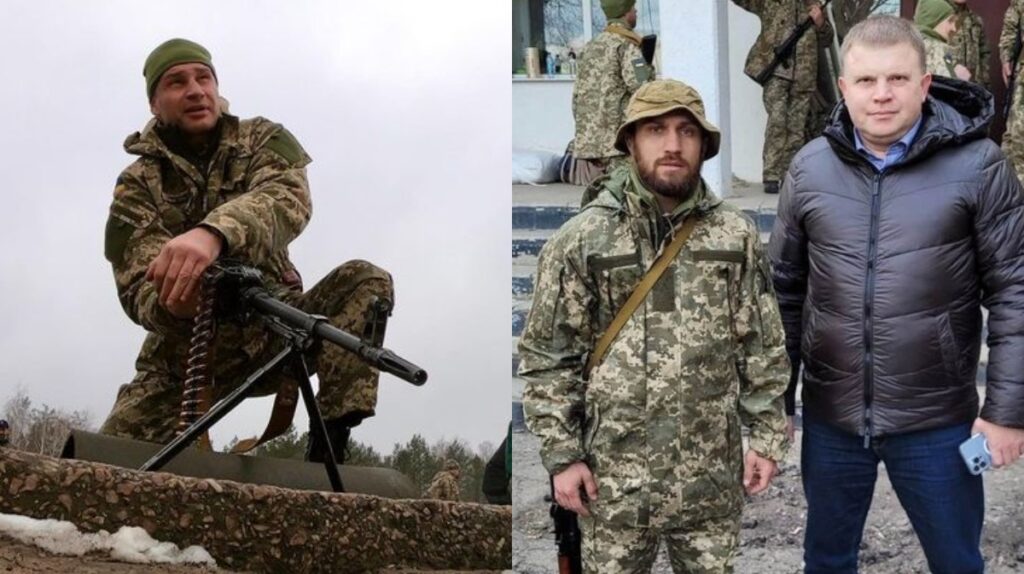
Amosov is one of several high profile Ukrainian fighters taking up arms against a Russian invasion that has so far claimed the lives of hundreds of civilians. Boxing greats Vitali and Wladimir Klitschko, who are reportedly on Russian President Vladimir Putin’s ‘kill list,’ have also vowed to serve on the front lines. So too current boxing stars Oleksandr Usyk and Vasyl Lomachenko.
While these men and so many other Ukrainians are risking their lives to defend their homeland, it almost seems trivial to talk about the implications that the Russian invasion may have for MMA. But with much of the West placing economic sanctions on Russia and as the horrors of the war continue to unfold before us, should top promotions like the UFC and Bellator make an ethical decision to ban Russian fighters from competing?
Left: Former heavyweight boxing great and current mayor of Ukraine’s capital of Kyiv, Vitali Klitschko. Right: Pound-for-pound boxing great Vasyl Lomachenko in the military fatigues of the Belgorod-Dnestrovsky Territorial Defense Battalion.
A War Bleeding Into Global Sport
Last week, Polish-based MMA promotion KSW did just that, making what it termed an “ethically justifiable decision” to cancel Russian fighter Shamil Musaev’s upcoming fight. While this decision must be considered within the context of Poland’s close geopolitical proximity to the war in Ukraine, the ban followed similar actions taken by some of the world’s biggest sporting bodies.
Due to the Russian Federation’s invasion of Ukraine, KSW has made a tough, albeit ethically justifiable, decision to cancel Russian fighter Shamil Musaev’s fight, which was scheduled for KSW 68 on March 19th in Radom.
FIFA, soccer’s world governing body, has banned Russia from competing at the World Cup, and similar bans have also followed in tennis, hockey, athletics, and F1 racing. Countries, too, have made a point of punishing Russian athletes. Shortly following the invasion of Ukraine, the UK government cancelled visas issued to the men’s basketball team of Belarus, a close Russian ally, banning it from the country.
I have cancelled the visas of the Belarusian Men’s Basketball Team who were due to play in Newcastle tomorrow night.
The UK will not welcome the national sports teams of those countries who are complicit in Putin’s unprovoked and illegal invasion of #Ukraine.
This particular ban could have near-term implications for the UFC, which will hold its first event in the UK since the COVID-19 outbreak two years ago. UFC Fight Night: Volkov vs. Aspinall, set for March 19 in London, will feature four Russian fighters, including heavyweights Shamil Abdurakhimov, Sergei Pavlovich, and headliner Alexander Volkov. Their participation in the card is now in doubt thanks to the UK government’s hardline stance.
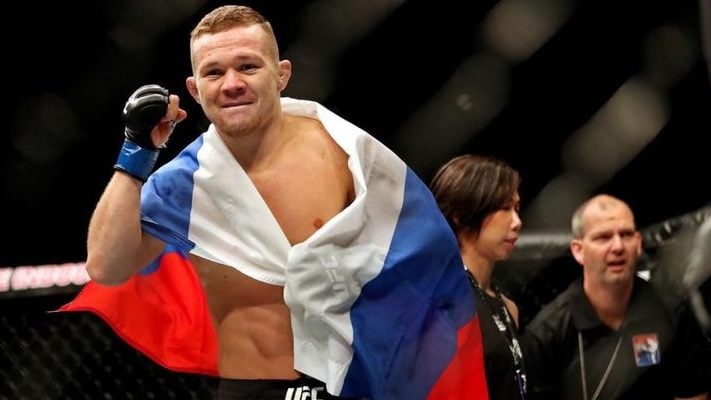
UFC President Dana White, whose forehead vein seems to be at bursting point most of the time thanks to the logistical nightmares presented by COVID-19, now has the political ramifications of a European war to factor into his event planning. Not only is the aforementioned Fight Night in doubt, but Petr Yan could also face difficulties entering the US for his long-awaited rematch with Aljamain Sterling at UFC 273 on April 9 in Jacksonville, Florida.
Petr Yan (PHOTO: USA TODAY)
“Like I tell you guys all the time, just when you think the world’s about to get normal again, it gets even nuttier,” White said in an interview with TSN last week. “If Petr Yan cannot get into the country?’ I have no idea what’s going to happen with Russia and all these other things. I don’t know.”
And it’s not only Petr Yan who may face visa challenges. You never know how the US government might treat a fighter like Khamzat Chimaev, who while a naturalized Swede, maintains close ties with Chechen warlord Ramzan Kadyrov—a loyal ally of Russian President Vladimir Putin.
The Argument Against Banning Russian MMA Fighters
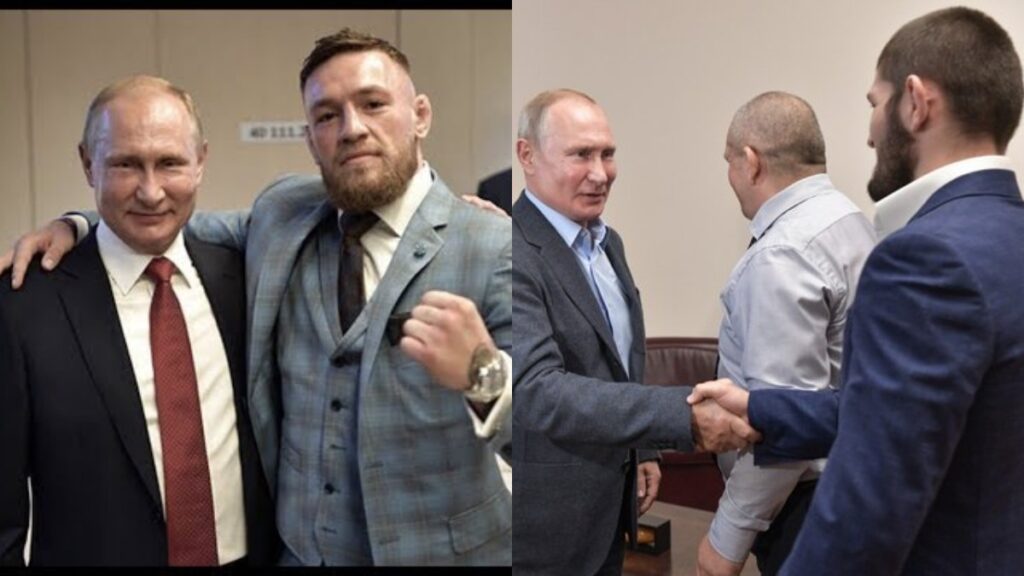
Vladimir Putin, like many strong-man leaders of the former Soviet Union, has a history of fraternizing with some of MMA’s biggest stars. A long-time relationship with Russian heavyweight great Fedor Emelianenko, in between much publicized meetings with Khabib Nurmagomedov and Conor McGregor, have all been part of his attempt to “sportswash” the many crimes of his regime.
A ban on Russians competing in the likes of the UFC or Bellator would therefore seem by some an appropriate punitive measure against Putin. But as the Russian military becomes bogged down in an increasingly difficult war, while suffering the dire economic consequences of US-led sanctions, banning Russian fighters—or any of its athletes, for that matter—is highly unlikely to register on Putin’s list of things to worry about, nor factor into his geopolitical decisions going forward. Rather, it will simply punish the fighters.
Regardless of any ethical argument in favor of a ban, the UFC, which under the guise of Dana White has historically been staunchly apolitical, is far from likely to place a ban on Russian fighters. Considering there are 27 Russians currently fighting in the promotion—the third largest national cohort after the US and Brazil—the effect on the UFC’s bottom line would be dire.
The Silence Of Russian Fighters
So, perhaps the ethical responsibility of denouncing the Russian invasion falls upon the nations fighters? Newly-signed Ukrainian UFC light heavyweight Ihor Potiera believes so. Last week, the Contender Series alum called out freshly-minted UFC Hall of Famer Nurmagomedov for remaining silent on the conflict.
“You were loved by millions,” Potiera said in an Instagram story (h/t Bloody Elbow). “You’ve been an example in many martial arts gyms. You started your career in Ukraine. You speak about honor and faith. And now you are silent.”
Khabib, however, isn’t the only Russian MMA fighter to remain silent on the Ukraine war. Thus far, only Petr Yan has made a statement, posting a peace symbol in a since-deleted Instagram story. However, it must be noted that in a country like Russia, no matter how nominally democratic it is, those who voice dissent at a time of war could face severe consequences.
But while the UFC’s Russian fighters have remained silent, those from Ukraine certainly haven’t. And perhaps the most outspoken has been women’s flyweight Maryna Moroz, who following her victory at UFC 272 on Saturday, delivered an emotional speech that showed just how real the conflict is for Ukraine’s fighters.
“My family is in Ukraine,” said Moroz to the Las Vegas crowd. “I had a hard week. I worried, I cried, because my family is right now in a bad situation. Thank you to everyone who messaged me, because this week was hard for me. I want to cry because of this war my country is in.”